The tour begins outside a Burger King on Liberty Street in Lower Manhattan, and the guide explains why. People forget that this was commandeered by the police on Sept. 11, 2001, as a staging area amid the chaos, “NYPD Temp HQ” spray-painted over the front door.

What follows is a very specific narrative of the events of that day as told by a very specific guide, Christina Stanton, who lived it firsthand. She continues to watch it unfold, 25 years on.

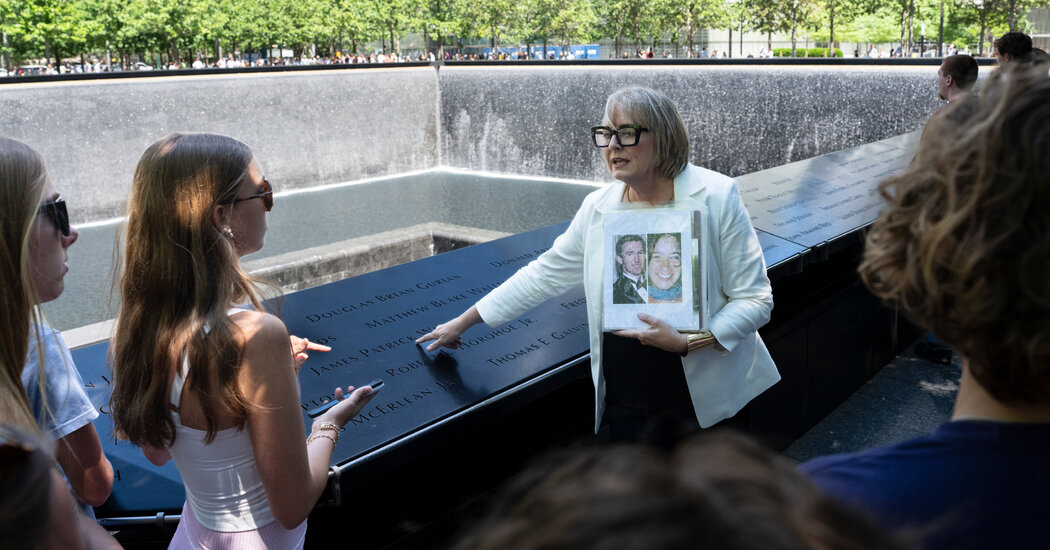
The first stop: an elevated park just south of where the twin towers stood. “I want to draw your attention to the yellow building back there,” she directed a school group from Indiana during a tour this May. She pointed out 21 West Street, where she moved with her husband, Brian, in July 2001. They were newlyweds, living on the 24th floor with a fabulous terrace.

She was 31 then, and had been a licensed tour guide for six years. “It was supposed to be my hustle,” she explained, adopting a haughty accent. “‘I’m a Broadway actress.’”

She gave tours all over Manhattan. Her World Trade Center tour, close to home, began and ended at the 25-ton Koenig Sphere in the plaza between the towers. She’d once taken her mother to Christmas brunch in the Windows on the World restaurant high up in the North Tower, and now the World Trade Center was essentially in her front yard.

“I’m here,” she told another group this July, teenagers from a church in Phoenix, thinking back to those years. “I’m living in New York. I’m living my best life.”

And then came that clear Tuesday morning in September.

A New York City walking tour is a honed monologue of fact, trivia and one-liners. Maybe a pit stop for a local bite. Ms. Stanton’s tour quickly grips its listeners in an escalating tale of dread, locking them — often young people not yet born on that day — into a breathless silence.

“The impact of the first plane shook our building,” she said. She and Brian had stood, dazed, on their terrace and watched smoke and flames rise from the upper floors of the North Tower. Below, hundreds of people were stopped on street corners, looking up.

Then a deafening roar in the sky raced closer.

“That went right over our shoulders,” she said. It’s hard for her to describe the earsplitting scream of a commercial jet at such high speed and low altitude. She watched it tilt its wings at the last second, as if to strike more floors.

The couple were blown backward into their apartment. “I was on the floor, and my husband was screaming,” she told a couple from New Hampshire, visiting the city this April.

She and Brian gathered themselves, and their overweight Boston terrier, Gabriel, and hurried to the stairs, where neighbors — yelling, crying — were making their way down to the street. There, crowds ran past holding briefcases or whatever they could find over their heads, for fear of falling debris.

“What was I wearing?” she asked the Phoenix group.

“Pajamas?” a few teenagers guessed.

“With no shoes,” she added.

She turned to re-enter her building, but a doorman, intent on evacuating residents, blocked her way. Brian offered her his shoes. No, she said. But give me your socks.

They hurried downtown to the southern tip of Manhattan.

Leading tours, she points west toward the sea wall, where she, Brian and their dog came to find themselves facing the harbor. Then the South Tower fell. In an instant, the sunny refuge they had found was overwhelmed, and they were smothered in dust and smoke and debris. Ms. Stanton, gagging and choking for air, found herself — bizarrely — remembering the fun facts from her old tours.

Forty-seven thousand employees.

Twelve million square feet.

Forty thousand doorknobs.

“We were running around in that, trying to find places to breathe,” she told the couple from New Hampshire. “‘Are we going to die?’ You just don’t know what’s happening next.”

And here in her tour spiel, Ms. Stanton’s bulletproof cheer and love for the city can almost wave away all that dust for a moment.

“Has anybody here heard of the boat rescue on 9/11?” she asked the Phoenix teenagers.

Silence.

“Who doesn’t love hero stories?” she asked.

The harbor had quickly filled with dozens and dozens of boats — ferries, party boats, tugboats, family-owned boats. Boats christened the George Washington, the Theodore Roosevelt and the Alexander Hamilton joined the Frank Sinatra, the Yogi Berra and the Chelsea Screamer in a massive and spontaneous waterborne evacuation.

Some boats arrived at piers. Others just motored as close as they could to the shoreline. Ms. Stanton and her husband stood in line behind the Museum of Jewish Heritage to board a tugboat, but it filled up and left before their turn.

Then a ferry arrived. It approached the edge of the sea wall, but its deck was still a good seven to 10 feet below the people standing atop the embankment.

Two ferrymen lifted Ms. Stanton, still in her pajamas and trying to blink away dust from her eyes, over the wall and dropped her into the boat. Brian and their dog followed.

The ferry chugged across the Hudson River and dropped them at a place Ms. Stanton had never heard of: Paulus Hook, N.J., in the shadow of the landmark Colgate Clock.

They disembarked and took stock. Two adults and a dog, covered in grit and dust, in an unfamiliar neighborhood of warehouses and industrial spaces. They shuffled along, pausing now and then to prevent Gabriel from licking the crust off his fur.

Suddenly and desperately, Ms. Stanton needed a bathroom. When the couple saw a young woman approaching a new-looking apartment building, they asked if there was a restroom. The woman realized where they were coming from, and took them up to her apartment.

There, they met the woman’s husband — David, maybe? — and used their bathroom. David, stunned, offered them glasses of water, and the Stantons stood awkwardly for a minute, too dirty to sit, before they left.

They walked about a mile past warehouses and over light-rail tracks to a B.J.’s Wholesale Club. Inside, a wall of televisions was showing live feeds from the place they had just escaped.

Customers gaped at the ashen newcomers who seemed to have stepped out of those televisions. The Stantons bought supplies, including a pair of shoes for Christina. (Brian had grabbed his wallet.) Outside, a line of yellow-dusted men and women waited for their turn at a phone booth.

The days that followed were a blur. Later that week, they were briefly allowed back in the apartment to retrieve essentials. They’d never closed their terrace doors that day, so the living room was coated with debris — bits of paper, receipts, a scrap of a balance sheet. A diorama of things that once mattered.

Like many who could, they fled the city, making their way to Tallahassee, Fla., where Ms. Stanton’s mother lived. They stayed for a few months.

But by spring 2002, she and Brian were back in their West Street apartment. Staying away never felt like an option. Somewhere in that chaotic time for the city and the nation, Ms. Stanton realized that living in New York was not her best life — it was life.

Tourism dried up after Sept. 11, for a time. From her terrace, Ms. Stanton watched the slow transformation of ground zero. And then her work, like her city, picked up again.

She booked tours through hotels, event planners and groups like Junior Tours, which caters to students. She worked all over the city, from Central Park to Little Italy and Chinatown to the Financial District.

And eventually, she reprised her former World Trade Center tour. At the start, it didn’t go well. Nobody, she realized, wanted a crying tour guide.

She got better. Those early tours had a just-the-facts quality. But over time, she gradually added her experiences from that day into her speech. The impact of the second plane. Her husband’s socks. The boats.

Word spread on social media, and people began to request her tour in particular. And being a tour guide stopped feeling like a side hustle.

Twenty-five years later, the tour, like life, continues to evolve.

During a stop with the Phoenix teenagers, a girl raised her hand.

“You said you were in that cloud of smoke?” she asked.

“Yes.”

“Have you been OK since then?”

“I have not,” she replied.

“The Christmas before last, I wasn’t feeling so good. I went to a doctor, who said: ‘No, you’re not doing so good. You have cancer.’”

Testing showed Ms. Stanton’s cancer was consistent with the 9/11 illnesses that have killed thousands of emergency responders in the last 25 years. But it wasn’t something that only happened to firefighters and police officers, she realized. They’d all breathed the same dirty ash.

In 2025, she underwent a hysterectomy. It left her free of cancer. Then she received a skin cancer diagnosis this year that may also be related to 9/11.

One could imagine that, having survived the day’s horrors, only to face cancer and surgery almost a quarter-century later, one would be done with that place.

But Ms. Stanton keeps coming back to the site of the attacks, again and again and again. She often tears up, speaking of two friends at a brokerage firm who were dating and who died in the towers. Or how Gabriel, her dog who hated everybody but his owners, was such a good boy that day, trying to clean his fur. He was never the same. “The glass had shredded his esophagus,” she said. He later died of cancer.

Why keep reliving that?

Because.

Because the boat rescue is praised as the largest maritime evacuation in the country’s history — it has been called the “American Dunkirk” — and there is a documentary about it narrated by Tom Hanks, and yet few on her tours seem to have heard of it.

Because not everyone realizes that the number of illnesses and deaths linked to the attacks continues to grow, far surpassing the number of people who died that day.

Because, surrounded by plaques and statues and the reflecting pools and the broken hull of that huge metal sphere, she, too, is a memorial.

Leave a Reply

Your email address will not be published. Required fields are marked *