Fast-Moving Reno Wildfire Forces Thousands to Evacuate in Nevada
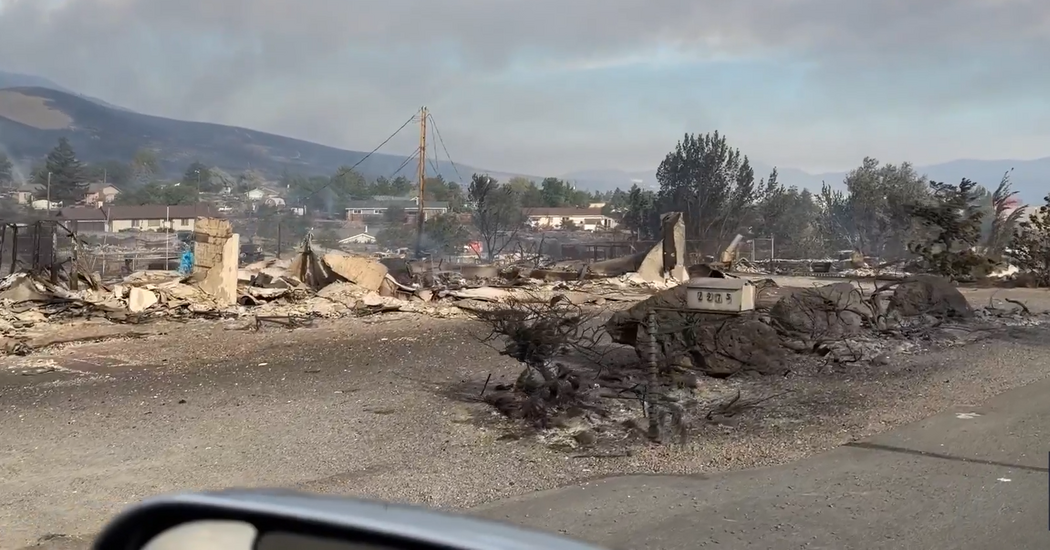
Firefighters on Monday were still trying to tame a wildfire that forced thousands of people from their homes as it threatened Reno, Nev.
The blaze, known as the Hawk fire, has burned more than 15,000 acres since it began Saturday in the Sierra Nevada foothills. Officials said Monday afternoon that the blaze was 27 percent contained.
About 45,000 people were evacuated, and an additional 40,000 were warned that they might need to leave at a moment’s notice. But some areas began to reopen to residents on Monday, and other evacuation orders were eased.
Mayor Hillary Schieve of Reno urged people to return to their homes only after they received an all-clear in order to prevent further strain on public safety resources and lessen risks for rescuers.
“We end up putting others’ lives at risk because they got to go in and help you,” she said. “So when we ask you to do it, we’re also asking you to help save other lives.”
Marcus Butler, 30, a Lemmon Valley resident, evacuated his home Saturday and stayed for two nights at a Hampton Inn in Sparks, adjacent to Reno.
On Monday morning, he showed up to the Reno-Sparks Convention Center, which is serving as an evacuation shelter for those fleeing the Hawk fire, to see if he could stay in his car in the parking lot. He hadn’t seen smoke in the sky, but his home remained in a no-go zone. “Maybe the fire’s hidden and we can’t see it,” he said.
On Sunday evening, firefighters had expected the blaze to reach “pockets of dense fuels” as it advanced toward Reno, a city of almost 300,000 near the border of Nevada and California.
But on Monday, local officials expressed optimism in their efforts to handle the fire, particularly at the southern end of the blaze, where firefighters largely stopped it from advancing.

“Fire behavior was less extreme than anticipated in some areas, allowing crews to hold established lines and reposition resources to reinforce suppression efforts,” city officials said in a morning update.
Extreme heat, dry conditions and strong winds have helped the Hawk fire expand. It is the second large blaze in the area in the past three weeks.
Arid conditions have propelled an active wildfire season across the American West this summer. In Washington State, hundreds of homes and more than 400,000 acres burned. In Oregon, a record 2.4 million acres have burned in 2026, according to state authorities.
Mr. Butler is wrapping up his job as a summer camp manager in Portola, Calif., and is set to move home to New England. “More floods, but no more wildfires,” he said. “I know it’s flooding out there, but I’d rather take the floods instead of the fires.”
In Nevada, hot and dry conditions, fuel and mountainous terrain will complicate efforts to suppress the flames. Winds were expected to pick up Monday afternoon.
The fire’s western portion remained a challenge, and firefighters were working to keep the blaze out of flatter terrain. City officials also cautioned that the fire could spread northeast and northwest.
Six people, including three firefighters, have been injured. It was not clear how many structures the wildfire has burned down or damaged.
Officials said that the fire was caused by a person but did not say whether they had suspected arson.
More than 750 personnel are assisting with the firefighting effort, not including the National Guard and the local police, who are helping safeguard neighborhoods.
Barry and Karen Lewis had been eyeing the Hawk fire’s smoke since midday Saturday and prepared to evacuate from their Lemmon Valley home. When they got evacuation alerts, they quickly left in their R.V.
The husband and wife have lived in their home since 2010 and said they had assumed that being in a desert area meant fewer wildfire risks.
“All the movies, you see the fires in the forest,” said Mr. Lewis, 72.
Judson Jones contributed reporting.